REFERENCES
|
As much as possible, all decisions regarding weapons, armour, clothing and equipment are based on archaeological finds, on sculpture, epigraphy (ancient texts) and wall paintings and floor mosaics. Where it isn't possible to find evidence from the reign of Septimus Severus, then I've moved slightly earlier, or in some cases slightly later, to find evidence as close to my chosen time period as possible. |
 |
BOOKS
Birley, Anthony The African Emperor, Batsford (1972)
Bishop, M and J. Coulston, Roman Military Equipment, Oxbow (2006)
Cambell, B The Roman Army 31BC - AD337 A Sourcebook, Routledge (1994)
Cornell, T and John Matthews Atlas of the Roman World, Facts on File (1982)
Cowan, R Imperial Roman Legionary AD161-284, Osprey (2003)
Croom, A Roman Clothing and Fashion, Tempus (2000)
Elliott, P Warrior Cults, Blandford Press (1995)
Elliott, P The Last Legionary, Spellmount (2007)
Goldsworthy, A The Complete Roman Army, Thames & Hudson (2003)
James, S Excavations at Dura Europos 1928-1937 - Final Report VII, British Museum Press (2004)
Ottoway, P Roman York, Tempus (2004)
Peterson, D The Roman Legions Recreated in Colour Photographs, Window & Green (1992)
Scarre, C Chronicle of the Roman Emperors, Thames & Hudson (1995)
Southern P and Karen Dixon The Late Roman Army, Routledge (1996)
Stephenson, I Roman Military Equipment - The Later Empire, Tempus (1999)
Sumner, G Roman Army: Wars of the Empire, Brassey (1997)
Sumner, G Roman Military Clothing (1),Osprey (2002)
Sumner, G Roman Military Clothing (2), Osprey (2003)
Sumner, G Roman Military Dress, History Press (2008)
Vegetius: Epitome of MIlitary Science, translated N.P. Milner, Liverpool University Press (1993)
Wilcox, P Rome's Enemies 1: Germanics and Dacians, Osprey (1982)
ON-LINE
Roman Army Talk Online forum for Roman historians, re-enactors, writers and artists
RomanLegions.info Fantastic online resource for Roman coins, scultpure and Roman military artefacts
Florentivs.com A 1st century Roman re-enactor provides advice of kit and weaponry
Legio XX The standard for all 1st century Roman re-enactors, full of great information!
FECTIO A Dutch Late Roman re-enactment society, with a fantastic site full of links, articles and informaton in depth on the later Roman army.
The Scottish Campaigns of Septimus Severus PDF analyzing his Scottish campaign 208-211AD
Lucius Septimus Severus Severus on Livius.org, the ultimate online ancient reference.
Quinta - A small group of Roman re-enactors operating out of Arbeia, the Roman fort at South Shields. Quinta recreates the soldiers of Cohors Quinta Gallorum, circa AD 220.
Roman-Britain.org An exceptional site, compiling maps,inscriptions and reports to produce a wonderfully complete database of sites from Roman Britain. Always go here first when looking for site information. The link takes you directly to the site's military page.
Denis Gvozdikov Another enthusiast of the Roman 3rd century legions, Denis portrays a member of the Twentieth Palmyran Cohort based at Dura Europus.
Populares Vindelicenses Based in Augsburg, Germany, this is a wonderful 3rd century civillian and military re-enactment group.
Legio II Italica A Bavarian group of re-enactors who focus on the 3rd and 4th centuries.
Roman Army Talk Online forum for Roman historians, re-enactors, writers and artists
RomanLegions.info Fantastic online resource for Roman coins, scultpure and Roman military artefacts
Florentivs.com A 1st century Roman re-enactor provides advice of kit and weaponry
Legio XX The standard for all 1st century Roman re-enactors, full of great information!
FECTIO A Dutch Late Roman re-enactment society, with a fantastic site full of links, articles and informaton in depth on the later Roman army.
The Scottish Campaigns of Septimus Severus PDF analyzing his Scottish campaign 208-211AD
Lucius Septimus Severus Severus on Livius.org, the ultimate online ancient reference.
Quinta - A small group of Roman re-enactors operating out of Arbeia, the Roman fort at South Shields. Quinta recreates the soldiers of Cohors Quinta Gallorum, circa AD 220.
Roman-Britain.org An exceptional site, compiling maps,inscriptions and reports to produce a wonderfully complete database of sites from Roman Britain. Always go here first when looking for site information. The link takes you directly to the site's military page.
Denis Gvozdikov Another enthusiast of the Roman 3rd century legions, Denis portrays a member of the Twentieth Palmyran Cohort based at Dura Europus.
Populares Vindelicenses Based in Augsburg, Germany, this is a wonderful 3rd century civillian and military re-enactment group.
Legio II Italica A Bavarian group of re-enactors who focus on the 3rd and 4th centuries.
|
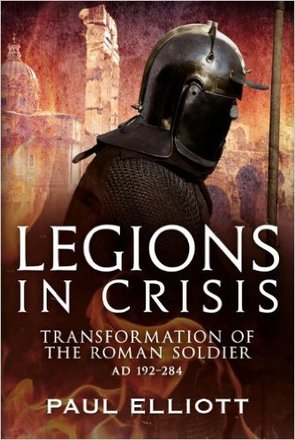
LEGIONS IN CRISIS by Paul Elliott The Roman Empire stumbled and almost fell in the 3rd century AD, weighed down by civil war, usurpers, invasion, plague and inflation. Rome teetered on the brink of disaster. Legions in Crisis looks at the crippling body blows inflicted on the Roman Empire during this 3rd century trauma. In particular it charts the changes that the legions underwent, sometimes by imperial decree, at other times through necessity. The idea of the legions as an unchangeable, undefeatable elite is challenged here as we see the army transformed along with its equipment and weaponry. The book begins by explaining how the changes in the period 200 300 first came about, moves on to look in detail at the legions and how they started to differ in organisation and weaponry to those of the past, then moves back to chart the bloody military history of the end of the 3rd century. Key events that shape our understanding are explained, including the rise of Septimius Severus, the fall of Dura Europus and the tough stance of the eastern queen, Zenobia. Discussion of artefacts, equipment, clothing and weaponry is enhanced through the experiments and reconstructions of the author who has specialized in the 3rd century Roman period. THE LAST LEGIONARY
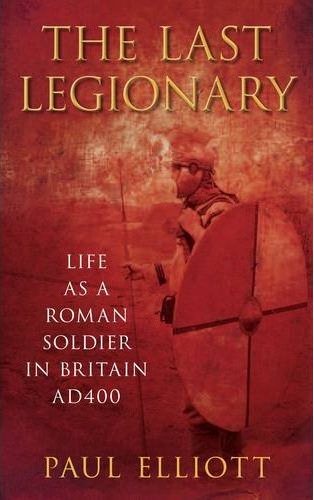
by Paul Elliott I wrote this book back in 2005-2006 and it covers a later period of Roman history, that of Constantine and the later empires - the Late Roman Empire. This book covers all aspects of Late Roman military life, from recruitment to weaponry, marriage to wages, warfare to religion. It explores the world of the Roman soldier, through the eyes of one man, posted to a British garrison at the edge of the empire facing the imminent collapse of Roman rule. In an evocative and highly comprehensive text, I try to follow the soldier's life through training and battle, marriage and business dealings, finally following him south as he leaves Britain for good in defence of Rome, thereby tying together the many social and historical threads that would have made up the career of such a soldier, one of the last legionaries. In order to create a text that is as accurate and detailed as possible, I've used my re-enactment experience and conducted many experiments to discover how military equipment in this period was made, used and worn. My results and observations add a depth and immediacy to the subject. This is a book that will fascinate and intrigue all those interested in the Late Roman period. |
|
Reviews of The Last Legionary
R.A. Kyme: "The final days of Roman Britain through the eyes of a foot soldier, who rises up through the ranks. It tells the story of his beginning, recruitment, training, battle experiences and the hardships as the Western Empire started to come under strain. The whole story is interspersed with current knowledge pulled from archaeology and from contemporary literature. I could not stop reading this book, the style is addictive and informative. Not a dry read. Certainly for an introduction to this period it is one I would fully recommned. As to myself well I am a re-enactor of some 12 years, chiefly Napoleonic, I fully appreciated the explanation of weapons, fighting style and the horror of injuries from the skirmishes and battles detailed in the book. This would be money well spent."
D. Evans: "You could easily fill a small library with books and articles written about the great legions of Caesar's day or the army of the High Empire. Yet in comparison the later Roman Army has been largely ignored, and what most people think they know about the last legions are completely incorrect. A large part of this gap in knowledge is due to a lack of contemporary sources for the period, as well as a lack of readable and accessible histories.
Paul Elliott attempts to tackle this heavy subject by presenting the life of the late Roman legionary through the eyes of a soldier called Gaius. His story gives the book narrative, as we follow his career from his enlistment in AD 383, to his engagement with the Goths in AD 402. Along the way we learn about training, weapons, clothing and equipment, daily life and payment, the fort, life on the march, religious beliefs and the experience of battle. Paul Elliot makes use of primary and secondary sources, archaeology and even a few tips and experiences of late Roman re-enactors. This makes some passages of the book rather subjective, but the author is usually helpful at pointing out what are the facts and what is guess work.
If you have ever wondered what life must have been like for the last legionaries as they set sail from Britain to defend the continent, then this book is one of the most readable and accessible. It gives you all the information from army organisation to the little details such as what type of soup did the soldiers eat, and what did they do to repair damaged equipment on the march. The book also contains a few black and white photographs of re-enactment equipment and fort buildings, as well as diagrams. Overall I found this a great and informative read. Recommended!"
A. Walker: "I finally got round to reading the book, and at once started devoured it in one session. Very impressed! Written in a clear, lucid style that makes the book accessible to an extremely wide variety of readers, Paul manages to tread the difficult line between dry, disembodied fact and Disneyland hype brilliantly. I learned a lot from this book, and what's more, thoroughly enjoyed it. Thanks Paul."
Paul B (Caballo): I bought my copy in the British Museum this afternoon where a pile was prominently displayed! Started it on the train home- great stuff! And now finished it- excellent, and really enjoyed it. If you are a re-enactor and don't read this, you are really missing out...
Dave: this is a GREAT resource for 4th, 5th Century research. It goes as far as breaking down to the different articles of clothing, and how it was decorated. More...
